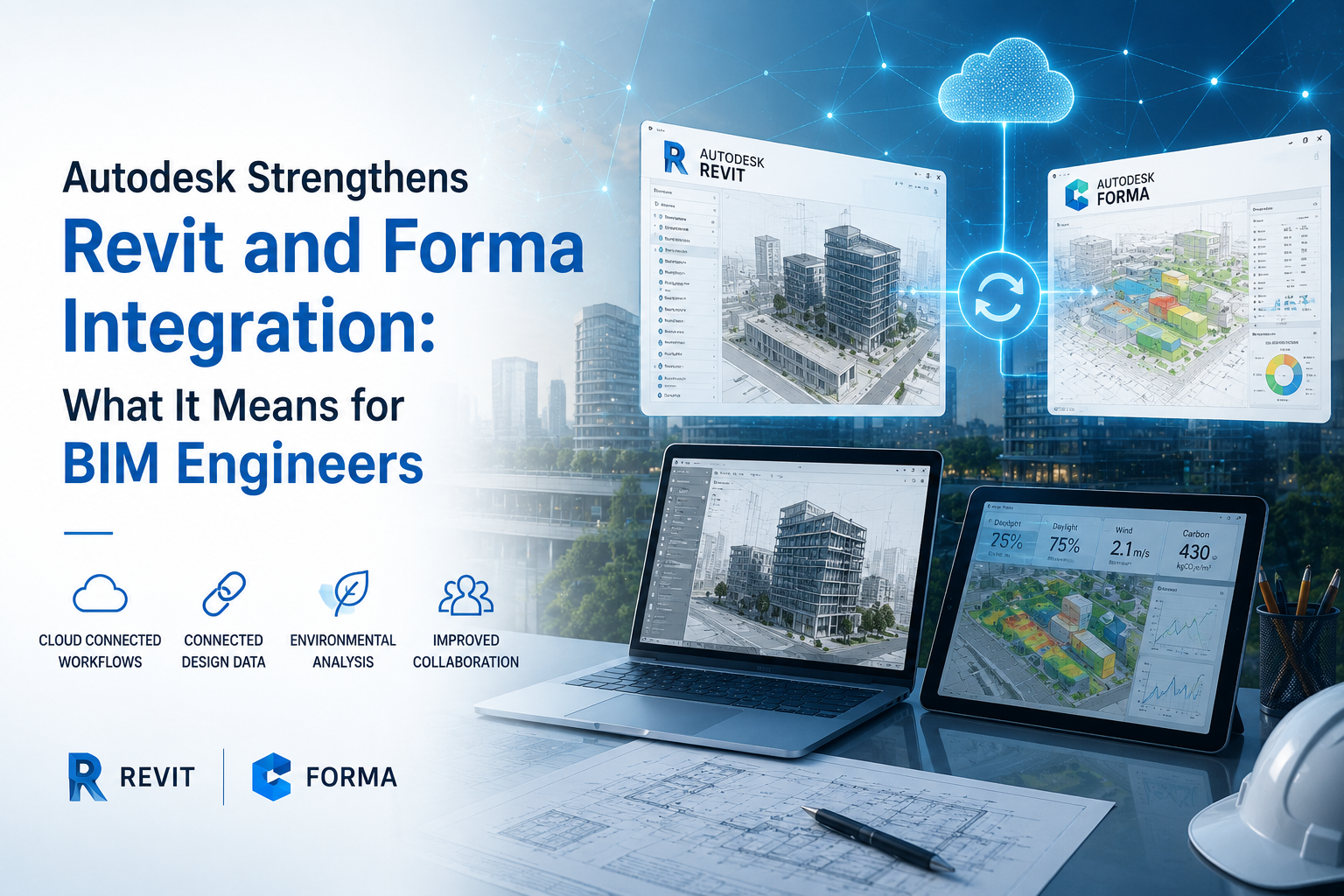
Autodesk Strengthens Revit and Forma Integration: What It Means for BIM Engineers
- Civil Engineering
- CADkul Team
- May 11, 2026
- 1 Comment
Discover how Autodesk's latest Revit and Forma integration improves BIM workflows, cloud collaboration, environmental analysis, and project coordination for architects, civil engineers, and BIM professionals.
Building Information Modeling (BIM) continues to evolve as Autodesk strengthens the integration between Autodesk Revit and Autodesk Forma. This latest enhancement bridges the gap between conceptual planning and detailed building design, enabling architects, civil engineers, structural engineers, and MEP professionals to collaborate more efficiently throughout the project lifecycle.
As the Architecture, Engineering, and Construction (AEC) industry rapidly adopts cloud-based digital workflows, this connected ecosystem reduces repetitive work, improves collaboration, and enables smarter design decisions from the earliest project stages.
What is Autodesk Forma?
Autodesk Forma is Autodesk's cloud-based platform for early-stage planning, site analysis, environmental analysis, and conceptual building design. It helps project teams evaluate multiple design options before detailed BIM modeling begins.
Forma enables engineering teams to:
- Analyze project sites using real-world data.
- Explore multiple building design concepts.
- Perform environmental analysis.
- Evaluate daylight, wind, and carbon performance.
- Collaborate using cloud-based project information.
By introducing sustainability and environmental insights during the planning phase, Forma helps engineers make more informed design decisions while reducing costly changes later in the project.
What's New in the Revit–Forma Integration?
Autodesk has introduced Revit as the first Forma Connected Client, allowing project teams to access shared design information directly from the Forma Industry Cloud.
Instead of repeatedly exporting and importing files between applications, engineers can now continue developing projects using connected project data, resulting in smoother collaboration and better information consistency.
Key Benefits of the New Integration
Connected Design Data
Planning data created inside Forma can now be utilized more effectively within Revit.
- Reduced duplicate work
- Improved design consistency
- Better project coordination
- Faster design iterations
- Improved communication across engineering teams
Environmental Analysis
Forma allows engineers to evaluate:
- Daylight simulation
- Wind analysis
- Carbon impact
- Site context
These insights help architects and engineers create more sustainable buildings while making performance-based design decisions earlier in the design process.
Improved Cloud Collaboration
Since project information is stored within Autodesk Forma's cloud platform, every project stakeholder can work with the latest design data.
Advantages include:
- Real-time collaboration
- Version control
- Reduced project rework
- Improved multidisciplinary coordination
- Faster project approvals
Better Early Design Exploration
Forma enables architects and planners to evaluate multiple layouts, façade concepts, and building configurations before detailed BIM development begins. This minimizes redesign efforts while improving project efficiency.
Why This Matters for Civil Engineers
Modern civil engineering projects require seamless collaboration between multiple disciplines. The enhanced Revit–Forma integration enables civil engineers to participate earlier during project planning while maintaining accurate and connected BIM information.
Benefits include:
- Earlier collaboration with architects.
- Reduced drawing inconsistencies.
- Improved site planning.
- Earlier clash detection.
- Faster infrastructure project delivery.
Benefits for BIM Professionals
- Faster project setup.
- Reduced manual data transfer.
- Integrated environmental analysis.
- Cloud-based BIM collaboration.
- Improved project visualization.
- Better design review workflows.
- Improved coordination across multiple disciplines.
Skills Engineers Should Learn
As Autodesk expands connected BIM workflows, engineers should focus on developing expertise in:
- Autodesk Revit
- Autodesk Forma
- BIM Coordination
- Digital Twins
- Cloud Collaboration
- Environmental Analysis
- Sustainable Building Design
- Common Data Environments (CDE)
Professionals with these skills are increasingly in demand across architecture, engineering, and construction organizations worldwide.
Industry Impact
The construction industry is rapidly moving from isolated desktop software toward connected cloud-based engineering platforms. Autodesk's latest integration reflects several important industry trends:
- Connected project data
- Cloud-first BIM workflows
- AI-assisted engineering design
- Digital engineering collaboration
- Sustainable building analysis
- Integrated planning and detailed design
These technologies are expected to become standard components of future BIM workflows, helping engineering teams improve efficiency while delivering more sustainable infrastructure projects.
Career Opportunities
Professionals skilled in Autodesk Revit, Autodesk Forma, and cloud-connected BIM workflows are increasingly sought after for positions including:
- BIM Engineer
- BIM Coordinator
- Revit Engineer
- Civil Design Engineer
- Structural BIM Engineer
- MEP BIM Engineer
- Digital Construction Engineer
- BIM Manager
Conclusion
The stronger integration between Autodesk Revit and Autodesk Forma represents another important milestone in the evolution of Building Information Modeling. By connecting conceptual planning, environmental analysis, and detailed BIM design through cloud technology, Autodesk is enabling engineering teams to work faster, collaborate better, and make smarter design decisions.
For engineering students, BIM professionals, architects, and civil engineers, learning modern cloud-connected BIM workflows alongside traditional Revit skills will be essential as digital engineering continues to shape the future of the AEC industry.

CADkul Team
CADkul Team is the official content team of CADkul, committed to delivering expert insights, industry news, and career-focused resources for aspiring automotive design engineers.

This is really helpful for beginners like me. Excited to explore the new features in Revit and Forma integration.
Kiran Alhat
🎓 Student 30 Jun 2026 03:05 PM