The Future of BIM: How Agentic AI is Transforming Building Information Modeling
- Civil Engineering
- CADkul Team
- May 02, 2026
- 1 Comment
Discover how Agentic AI is transforming Building Information Modeling (BIM) through intelligent automation, autonomous design assistance, cloud collaboration, digital twins, and next-generation engineering workflows for architects, civil engineers, and BIM professionals.
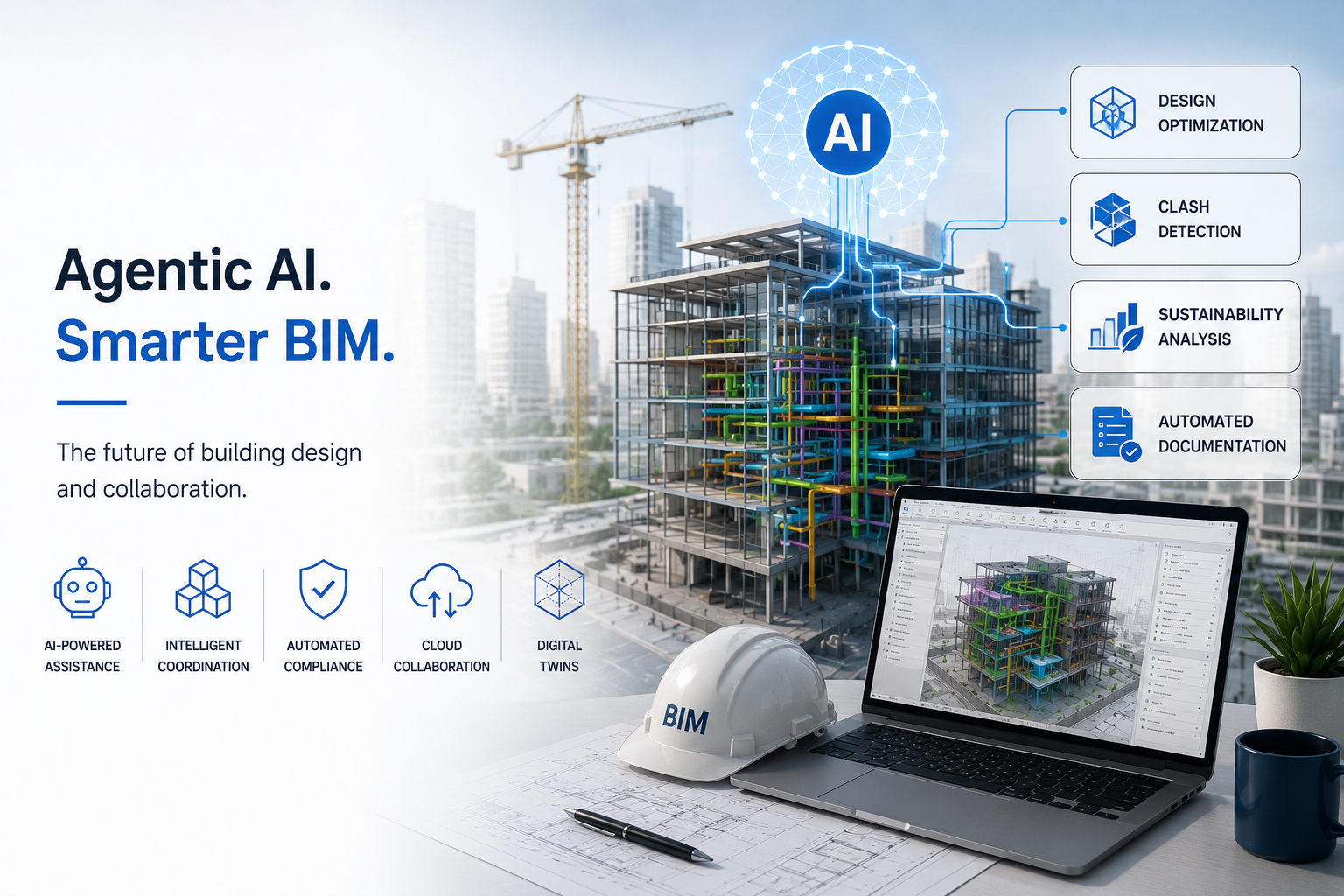
Building Information Modeling (BIM) is entering a new era with the rise of Agentic Artificial Intelligence (Agentic AI). While traditional BIM platforms have transformed how buildings are designed and coordinated, Agentic AI is set to make these workflows even more intelligent by enabling software to analyze information, make decisions, and perform engineering tasks with minimal human intervention.
Unlike conventional AI assistants that simply respond to prompts, Agentic AI can understand project objectives, coordinate across multiple disciplines, automate repetitive workflows, and continuously improve project outcomes. As the Architecture, Engineering, and Construction (AEC) industry embraces digital engineering, Agentic AI is expected to become one of the most significant innovations shaping the future of BIM.
What is Agentic AI?
Agentic AI refers to intelligent software agents capable of reasoning, planning, and completing engineering tasks autonomously. Instead of waiting for user instructions at every step, these AI agents can interpret project requirements, evaluate multiple options, and recommend optimized engineering solutions.
Within BIM environments, Agentic AI acts as a virtual engineering assistant that supports architects, civil engineers, structural engineers, and MEP professionals throughout the complete project lifecycle.
How Agentic AI is Changing BIM
Traditional BIM focuses on creating digital building models and coordinating project information. Agentic BIM goes much further by enabling intelligent automation throughout planning, design, coordination, construction, and facility management.
Agentic AI enables BIM teams to:
- Generate preliminary building layouts automatically.
- Analyze design alternatives using project constraints.
- Coordinate architectural, structural, and MEP models.
- Detect clashes before construction begins.
- Optimize sustainability and energy performance.
- Automate documentation and reporting.
- Monitor project changes across cloud platforms.
1. Autonomous Design Assistance
What It Does: Agentic AI can assist engineers by generating conceptual layouts, suggesting optimized building configurations, and recommending engineering improvements based on project objectives.
Benefits: Engineers can evaluate more design options in less time while focusing on creativity and technical decision-making.
Example: AI agents may recommend alternative floor plans, structural layouts, or optimized building orientations based on environmental analysis and project constraints.
Tip: Learning cloud-connected BIM platforms alongside AI-assisted design tools will become increasingly valuable for future engineering professionals.
2. Intelligent BIM Coordination
What It Does: AI continuously monitors architectural, structural, and MEP models to identify clashes, inconsistencies, and coordination issues before construction begins.
Benefits: Earlier clash detection reduces project delays, minimizes rework, and improves multidisciplinary collaboration.
Example: Instead of manually reviewing hundreds of clashes, engineers receive prioritized recommendations generated by AI.
Tip: Combining Navisworks, Revit, and AI-powered coordination tools can significantly improve BIM productivity.
Key Advantages of Agentic BIM
Automated Compliance Checking
AI agents can evaluate building designs against building codes, accessibility standards, fire safety requirements, and sustainability guidelines before construction documentation is finalized.
Cloud-Based Collaboration
Connected BIM platforms enable AI agents to synchronize project information across multiple disciplines while maintaining version control and data consistency.
Digital Twins
By combining BIM models with operational building data, Digital Twins enable AI to monitor building performance, predict maintenance requirements, optimize energy consumption, and improve long-term asset management.
The Role of Cloud BIM Platforms
Modern BIM increasingly relies on cloud-based collaboration where architects, engineers, contractors, and project owners work from shared project information.
Agentic AI further enhances cloud workflows by:
- Maintaining synchronized project data.
- Tracking design revisions automatically.
- Improving multidisciplinary collaboration.
- Reducing manual coordination tasks.
- Supporting real-time engineering decisions.
Industry Trends Driving Agentic BIM
The AEC industry is rapidly embracing intelligent digital engineering technologies. Several trends are accelerating the adoption of Agentic AI.
- Cloud-first BIM platforms.
- AI-assisted engineering design.
- Digital Twins for smart buildings.
- Automated code compliance checking.
- Sustainable building analysis.
- Generative design for architecture and infrastructure.
- Connected project data across the building lifecycle.
Skills Future BIM Engineers Should Learn
- Autodesk Revit
- Autodesk Forma
- Navisworks
- Dynamo for Revit
- BIM Coordination
- Digital Twins
- Cloud Collaboration
- Python for BIM Automation
- Common Data Environments (CDE)
- AI-assisted BIM Workflows
Career Opportunities
As intelligent BIM platforms become mainstream, professionals with AI-enabled BIM expertise will be increasingly sought after for roles including:
- BIM Engineer
- BIM Coordinator
- Digital Construction Engineer
- BIM Automation Specialist
- Computational Design Engineer
- Digital Twin Engineer
- Construction Technology Consultant
- BIM Manager
Practical Tips for Engineers
Develop expertise in cloud-based BIM platforms such as Autodesk Revit and Autodesk Forma.
Learn automation tools including Dynamo and Python to improve engineering workflows.
Understand Digital Twin technologies and how operational building data connects with BIM models.
Stay updated on AI-assisted engineering tools that improve coordination, documentation, and project delivery.
Participate in CADkul Certification Programs and BIM workshops to build practical industry skills.
Advice for Engineering Organizations
Engineering firms should invest in cloud-based BIM platforms, AI-powered coordination tools, and employee training to remain competitive in the rapidly evolving AEC industry.
Encouraging multidisciplinary collaboration and continuous digital skill development will help organizations maximize the benefits of intelligent BIM workflows.
Conclusion
Agentic AI represents the next major evolution of Building Information Modeling. By combining intelligent automation, cloud collaboration, Digital Twins, and autonomous engineering assistance, future BIM platforms will become significantly more efficient, connected, and data-driven.
For students, architects, civil engineers, structural engineers, and BIM professionals, developing expertise in AI-enabled BIM workflows today will create valuable career opportunities as the construction industry continues its digital transformation.
CADkul Team
CADkul Team is the official content team of CADkul, committed to delivering expert insights, industry news, and career-focused resources for aspiring automotive design engineers.

**"Great insights. Organizations that invest in both BIM standards and AI-driven technologies today will be better positioned to lead the digital transformation of the construction industry."
CADkul Team
👨🏫 Mentor 01 Jul 2026 05:33 PM