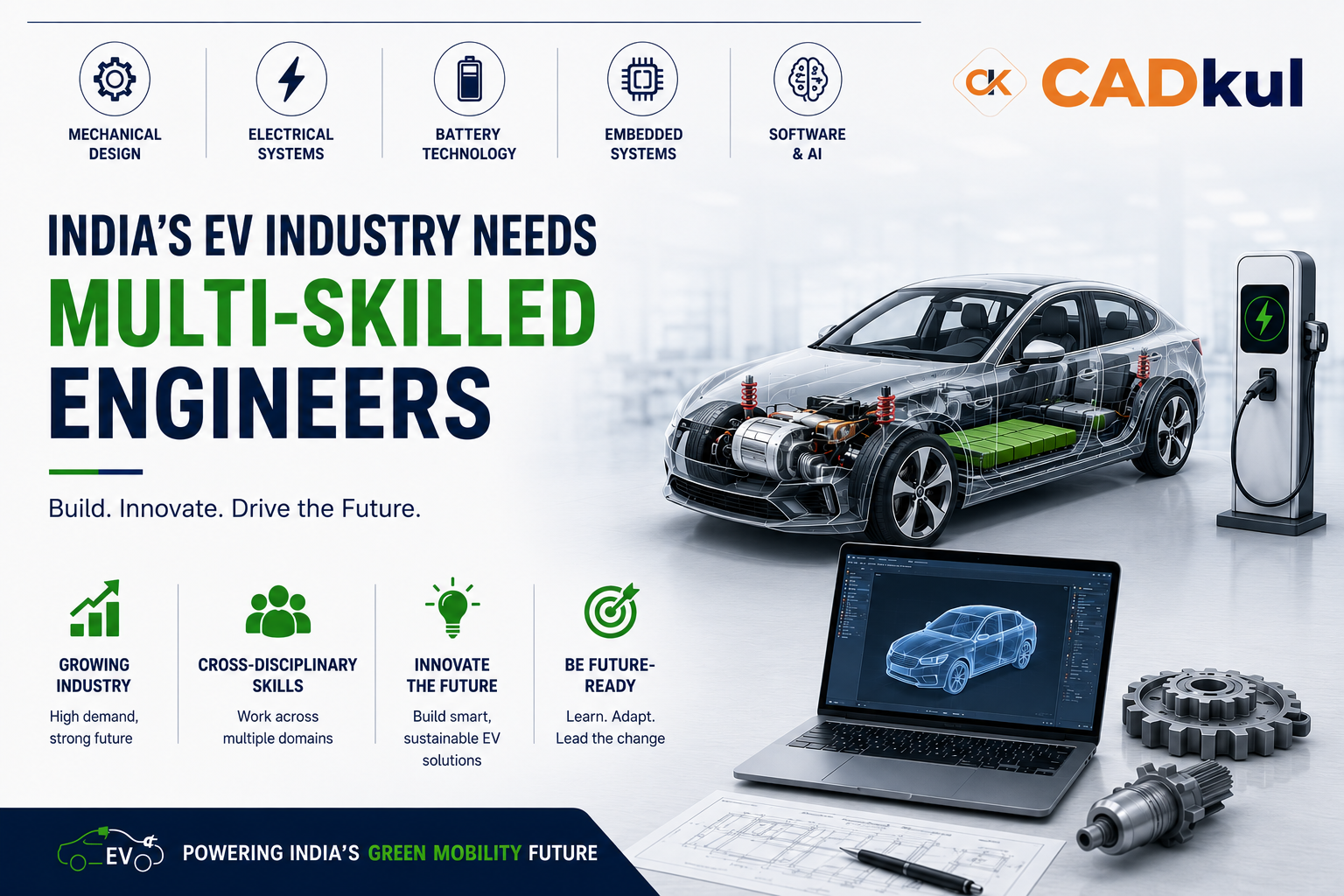
India's EV Industry Needs Multi-Skilled Engineers: The Future of Electric Mobility Careers
- Industry Trends
- CADkul Team
- April 07, 2026
- 0 Comments
India's electric vehicle industry is creating unprecedented demand for engineers with expertise in mechanical engineering, electrical systems, battery technology, embedded systems, software, and AI. Discover the skills, technologies, and career opportunities shaping the future of EV engineering in India.
India's Electric Vehicle (EV) industry is entering a transformative phase. As automakers, battery manufacturers, charging infrastructure companies, and mobility startups accelerate innovation, the demand for engineers with expertise across multiple engineering disciplines is growing rapidly.
Unlike traditional automotive engineering, EV development requires professionals who understand mechanical design, electrical systems, battery technology, embedded electronics, software development, and digital engineering. Industry leaders believe the next generation of engineers will need to combine these skills to build smarter, safer, and more sustainable electric vehicles.
For engineering students and professionals, this shift presents exciting career opportunities in one of India's fastest-growing industries.
Why India's EV Industry is Changing
Electric vehicles are fundamentally different from conventional internal combustion engine (ICE) vehicles. Modern EVs combine advanced mechanical components with intelligent electronics, software-controlled systems, AI, and connected technologies.
Today's EV engineers work on integrated systems that include:
- Electric powertrains
- High-voltage battery systems
- Battery Management Systems (BMS)
- Embedded controllers
- Electric motors
- Vehicle software
- Autonomous driving technologies
- Connected vehicle platforms
This convergence of technologies means engineers can no longer specialize in only one domain. Cross-disciplinary knowledge is becoming a competitive advantage.
The Rise of Multi-Skilled Engineers
Modern EV companies increasingly seek engineers who can collaborate across mechanical, electrical, electronics, and software teams. Understanding how these systems interact leads to faster innovation, improved product quality, and reduced development time.
Key benefits of multidisciplinary engineering include:
- Improved product development efficiency
- Better collaboration across departments
- Faster problem-solving
- Reduced engineering rework
- Greater innovation in vehicle design
Essential Skills Every EV Engineer Should Learn
1. Mechanical Engineering
Mechanical engineers remain essential for designing vehicle structures, suspension systems, thermal management, manufacturing processes, and lightweight components.
Key Skills:
- CAD Design (CATIA, Creo, SolidWorks)
- GD&T
- Finite Element Analysis (FEA)
- Thermal Engineering
- Manufacturing Processes
2. Electrical Engineering
Electric vehicles rely on sophisticated electrical systems for energy distribution, charging, and motor control.
Important Topics:
- Power Electronics
- Electric Motors
- Inverters
- Charging Infrastructure
- High Voltage Systems
3. Battery Technology
The battery is the heart of every electric vehicle. Engineers with expertise in battery chemistry, thermal management, battery safety, and Battery Management Systems (BMS) are increasingly in demand.
Growing Areas:
- Lithium-ion Batteries
- Solid-State Batteries
- Battery Management Systems (BMS)
- Battery Testing
- Battery Recycling
4. Embedded Systems & Electronics
Modern EVs contain dozens of Electronic Control Units (ECUs) that manage critical vehicle functions.
Engineers should understand:
- Embedded C Programming
- Microcontrollers
- CAN Communication
- AUTOSAR
- Sensor Integration
5. Software & AI
Software is becoming one of the most valuable components of modern vehicles. Features such as predictive maintenance, intelligent energy management, connected vehicle services, and Advanced Driver Assistance Systems (ADAS) depend heavily on software engineering.
Recommended skills include:
- Python
- C++
- MATLAB/Simulink
- Machine Learning Fundamentals
- Data Analytics
- Cloud Platforms
Future-Ready EV Engineer Skill Stack
✔ Mechanical Design
✔ Electrical Engineering
✔ Battery Technology
✔ Embedded Systems
✔ Software Development
✔ Artificial Intelligence
✔ Data Analytics
✔ Digital Engineering
Emerging Technologies Driving the EV Industry
The rapid evolution of electric mobility is creating demand for engineers familiar with next-generation technologies.
- Solid-State Batteries
- AI-assisted Vehicle Diagnostics
- Vehicle-to-Grid (V2G) Technology
- Digital Twins
- Predictive Maintenance
- Autonomous Driving Systems
- Cloud-connected Vehicles
- Smart Manufacturing
Career Opportunities in India's EV Industry
India's EV ecosystem is expanding across automotive OEMs, battery manufacturers, electronics companies, charging infrastructure providers, and mobility startups.
Popular job roles include:
- EV Design Engineer
- Battery Engineer
- BMS Engineer
- Power Electronics Engineer
- Embedded Software Engineer
- Vehicle Integration Engineer
- Simulation Engineer
- Electric Powertrain Engineer
- Validation Engineer
- ADAS Engineer
How Engineering Students Can Prepare
Students should begin building multidisciplinary skills while pursuing their engineering degree. Combining classroom learning with practical software knowledge and industry-focused training will significantly improve employability.
Recommended learning roadmap:
- Master CAD software such as CATIA, Creo, SolidWorks, and AutoCAD.
- Learn EV fundamentals and battery technology.
- Study MATLAB, Simulink, and Embedded Systems.
- Develop programming skills in Python and C++.
- Gain experience with simulation tools.
- Build engineering projects related to electric mobility.
- Participate in internships and industry certification programs.
Industry Outlook
India's electric mobility sector is expected to create thousands of new engineering opportunities over the coming years. Government initiatives, investments in battery manufacturing, charging infrastructure, and vehicle production are accelerating industry growth.
As EV technology continues to evolve, companies will increasingly value engineers who understand multiple engineering disciplines rather than a single specialization.
Conclusion
The future of India's EV industry belongs to engineers who combine expertise across mechanical, electrical, electronics, battery technology, and software engineering. Developing multidisciplinary skills will enable professionals to contribute to innovative electric mobility solutions while opening doors to exciting career opportunities.
For engineering students and professionals, now is the ideal time to invest in continuous learning, practical training, and industry certifications to stay ahead in India's rapidly evolving electric vehicle ecosystem.
Frequently Asked Questions (FAQs)
Why are multi-skilled engineers important in the EV industry?
Electric vehicles combine mechanical systems, electrical engineering, battery technology, embedded electronics, and software. Engineers who understand multiple disciplines can collaborate more effectively and solve complex engineering challenges.
Which engineering branch is best for EV careers?
Mechanical, Electrical, Electronics, Mechatronics, Automotive, Computer Science, and Instrumentation engineers all have excellent opportunities in the EV industry, especially when they develop cross-disciplinary skills.
Which software should aspiring EV engineers learn?
Popular software includes CATIA, Creo, SolidWorks, MATLAB/Simulink, AutoCAD, Python, C++, and simulation tools used for vehicle design and analysis.
Is battery technology a good career option?
Yes. Battery engineering, Battery Management Systems (BMS), thermal management, battery testing, and battery recycling are among the fastest-growing specializations in the EV industry.

CADkul Team
CADkul Team is the official content team of CADkul, committed to delivering expert insights, industry news, and career-focused resources for aspiring automotive design engineers.

Leave a Comment